1 · The problem
The credibility of a trading track record has long rested on two kinds of evidence: platform screenshots and third-party endorsement. Both have structural weaknesses.
- Screenshots can be forged. Simulated and live accounts look nearly identical in the UI, and cherry-picked winning periods are hard to detect.
- Reports can be edited afterwards. Drawdown, Sharpe, and win-rate figures remain editable after export, with no audit trail.
- Endorsement does not transfer. One institution's due-diligence conclusion cannot be reused cheaply by another.
KeepOne converts "this record existed at this moment and has not been altered" from a question of trust into a cryptographic question. At the end of each settlement period, the digest of that period's data is written to a smart contract on Base.
Key design: only digests go on-chain, never raw data. No account details, strategy parameters, or position-level information ever leaves the institution. The chain proves that a dataset existed at a point in time and is unaltered — it does not publish the dataset.
2 · base.keepone.dev: attestation engine
2.1 Data ingestion
The engine connects to four categories of sources through read-only interfaces. Credentials are constrained at creation time and carry no order, transfer, or withdrawal rights.
| Source | Access method | Retrieved |
|---|---|---|
| MetaTrader 5 | Investor password | Historical fills, positions, equity curve, net value |
| Interactive Brokers | Read-only API (TWS / Gateway) | Executions, net liquidation value, unrealized PnL |
| Crypto exchanges | Read-only API key (trading and withdrawal disabled) | Trade history, balance snapshots |
| Third-party evaluation systems | Platform-provided read-only export | Full trade ledger for the evaluation period |
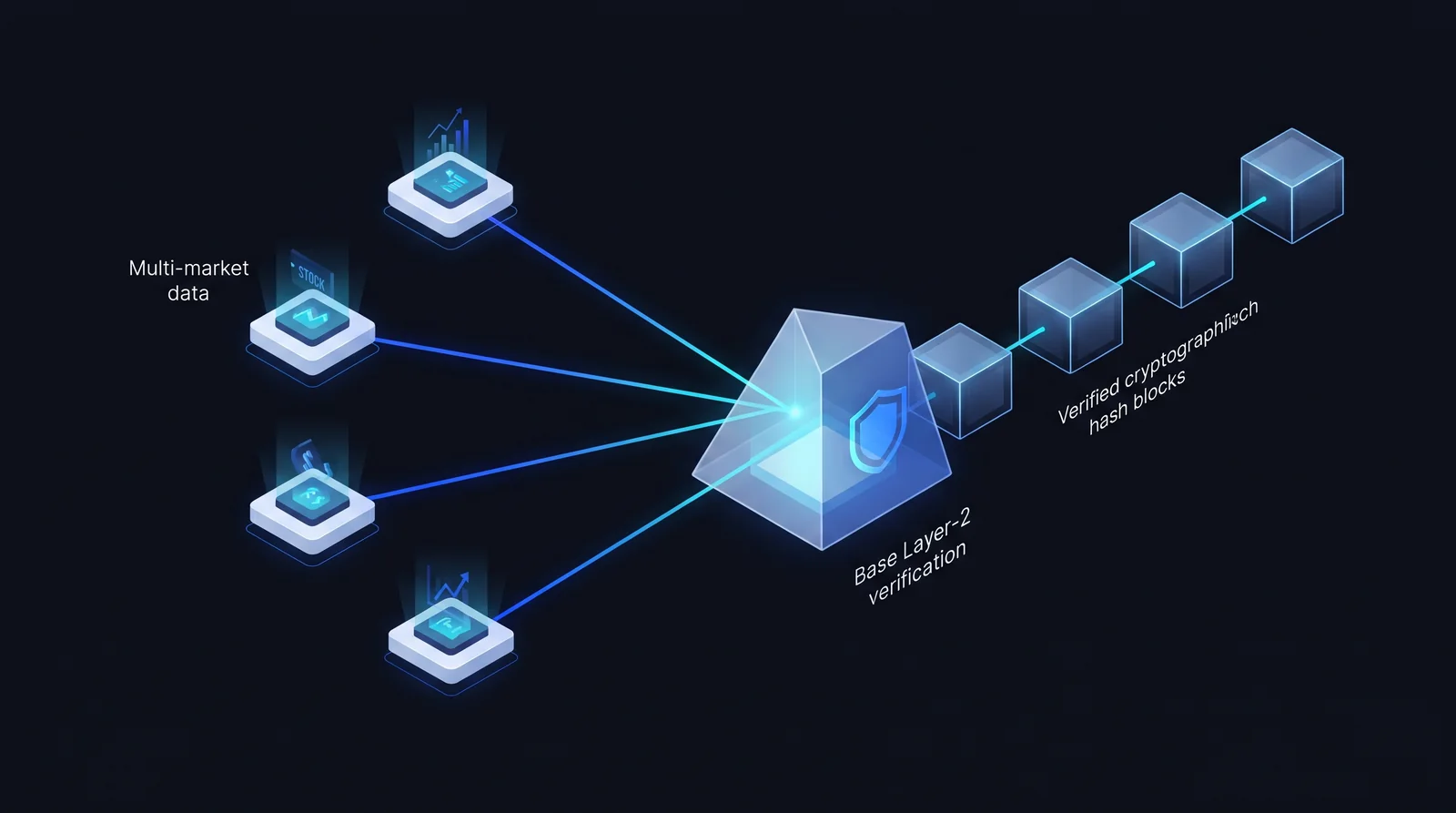
2.2 Data flow
2.3 Digest computation
One digest is produced per account per settlement period (UTC day):
- The normalized record set is serialized as deterministic JSON (fixed key ordering)
- A server-held salt (
PROOF_HASH_SALT, never published) is appended - SHA-256 is computed, yielding a 32-byte fixed-length digest
- The digest, account identifier, settlement date, and record count are written to the contract
The salt defends against dictionary attacks on low-entropy data: even with the digest in hand, an attacker cannot brute-force plausible trade combinations to reconstruct the original records.
2.4 Day sealing
A day is sealed the moment its digest is anchored. Afterwards:
- Resubmitting the same value returns 200 with zero writes (idempotent)
- Submitting a different value returns
409 DAY_CLOSEDwith the sealed proof identifier and both equity values - The record for that account and day therefore cannot be replaced
3 · 00001.hk: verifiable multi-agent analytics
00001.hk is an analytics terminal. It executes no trades and custodies no funds. What distinguishes it is that both its inputs and outputs are verifiable.
3.1 Verifiable inputs
Cross-market pricing and historical behaviour data come from records already anchored by base.keepone.dev rather than being collected independently. The inputs to any conclusion can therefore be reproduced by a third party.
3.2 Auditable outputs
Every AI-generated risk alert and analytical report is hashed with SHA-256 and anchored on-chain at creation time. Users can then establish whether a given report existed at a given moment and whether it was altered afterwards.
What this solves: if an AI model's predictions are only cited after the fact, there is no way to rule out selective memory of the correct calls. Anchoring outputs turns hit rate into a computable fact rather than a curated narrative.
4 · keepone.win: on-chain credentials
Trader performance during simulated evaluation is continuously verified by the attestation engine, forming a tamper-proof on-chain track record.
4.1 Why zero-knowledge proofs
A trader wants to demonstrate competence to an asset manager without handing over strategy parameters. Traditional due diligence forces a choice between the two: disclose everything, or prove nothing.
Zero-knowledge proofs let a trader prove a proposition — "my maximum drawdown stayed below 10% over twelve consecutive months" — without revealing a single position. The institution gets the risk evidence it needs; the trader keeps the strategy boundary intact.
4.2 Structure of a credential
| Layer | Content | Verifiability |
|---|---|---|
| Raw layer | Full trade record from the evaluation period | Visible only to the holder and authorised parties |
| Digest layer | SHA-256 fingerprint of the record | Public on-chain; proves existence |
| Claim layer | ZKP-proven risk metrics | Public on-chain; proves truth of the claim |
5 · keepone.dev: content provenance
The problem with financial content is not whether it is wrong. It is whether, after it turns out to be wrong, you can still see what it originally said.
When a creator publishes market research or a data visualisation, the platform computes a content fingerprint and anchors it to Base. Readers can verify whether that chart existed at a point in time and whether it changed afterwards.
The mechanism does not judge correctness. It guarantees integrity and ordering. For financial information that is often more important than correctness, because post-hoc edits, deleted unfavourable conclusions, and swapped chart data are the most common forms of contamination in the information ecosystem.
6 · Verification
This section describes how a third party independently verifies a record without trusting KeepOne. No call to our API is required at any point.
6.1 Prerequisites
- Contract address: announced on base.keepone.dev
- Network: Base (mainnet chainId 8453 / testnet 84532)
- Any Base block explorer (Basescan or similar)
6.2 Procedure
- Open the contract address in the explorer and enter Read Contract
- Call the query method with the account identifier and settlement date
- Record the returned digest, record count, and anchoring timestamp
- Request the corresponding raw records from the data holder
- Recompute the digest using the published serialization rules and the salt (supplied by the data holder)
- Compare the two digests
Note: the salt is not published on-chain and must be obtained from the data holder. Verification therefore requires their cooperation — but they cannot unilaterally deny a record, because the digest is already on-chain and they cannot produce a different dataset with the same digest.
7 · Security boundaries and permission model
| Role | Permissions | Constraints |
|---|---|---|
| Platform (KeepOne) | Read trade records within the authorised scope | No ordering, transfer, or withdrawal rights |
| Data source (broker / exchange) | Provide read-only interface | Boundary fixed at credential level, not escalatable |
| On-chain contract | Accept digests, serve queries | Receives no raw data and no funds |
| Third-party verifier | Read on-chain digests | Read-only; cannot write |
7.1 Why the salt stays off-chain
If the salt were on-chain, an attacker could brute-force common trade combinations and reverse the original records. Keeping the salt with the service and the data holder leaves only the digest public; both are needed to complete verification.
7.2 Key management
- On-chain writes use a dedicated relay wallet, isolated from any treasury wallet
- Private keys exist only server-side — never in version control, never in chat logs
- The contract restricts writes to authorised addresses
8 · Scope and disclaimers
This section states what the system does not do, to prevent misinterpretation.
- No fund custody. The platform holds no user funds and executes no trading instructions.
- No investment advice. All analytical output is technical risk assessment, not a recommendation.
- No return guarantee. On-chain attestation proves a record's authenticity and integrity, not its profitability.
- No endorsement of third-party results. Referenced simulated trading evaluation systems are independent of this platform.
- Not an audit. Attestation does not replace professional financial audit; they serve different purposes.
Technical note: the systems described here are under continuous development. Interface details, parameters, and deployment addresses are governed by the runtime state of base.keepone.dev.